Not every site gives you room to work. A narrow side passage, a rear lot with no vehicle access, an extension being built while the family stays in the house, a site bordered by retaining walls on three sides. These are real constraints that rule out conventional foundation methods before you have even picked up a shovel.
Screw piles were built for exactly this kind of work. Here is how they perform on restricted access sites and why more builders in South Australia are specifying them as the default solution when space is tight.
What Makes a Site Restricted Access
Restricted access is not just about whether a large excavator can fit through the gate. It covers a range of physical constraints that affect how foundation work can be carried out safely and efficiently:
- Narrow side passages. Many Adelaide homes, particularly those on standard suburban lots, have side passages as narrow as 900 mm. Getting any meaningful excavation equipment through a gap that size is not possible without risk of damaging fencing, footings or landscaping.
- Low overhead clearance. Carports, pergolas, eaves and overhead services all restrict the height of equipment that can operate on site. A conventional piling or drilling rig that stands 4 to 5 metres tall simply cannot work under a 2 metre eave.
- Occupied properties. Extensions and renovations are often built while the existing home is occupied. Noise, vibration, soil spoil and heavy machinery access all become serious constraints when the family is living 3 metres away.
- Boundary setbacks and adjacent structures. Infill development in established suburbs frequently requires foundation work close to existing footings or shared walls. Excavation in these situations carries real risk of undermining adjacent structures.
- Sloped or uneven terrain. Sites in the Adelaide Hills and foothills often combine tight access with significant slope, limiting the footprint available for equipment setup and spoil management.
Why Conventional Footings Struggle on These Sites
The standard approach to residential foundations relies on excavation: trench digging for strip footings, auger drilling for bored piers, or excavation for pad footings. Each of these requires equipment with a meaningful footprint, soil spoil to be removed from site, and in the case of bored piers, concrete trucks and pumping gear to follow.
On a restricted access site, these requirements stack up quickly into a problem. The excavator needs room to manoeuvre. The concrete truck needs road access. The spoil needs somewhere to go. When access is constrained, each of these steps costs more time, more money, and introduces more risk to surrounding structures and landscaping.
Bored piers present a specific additional problem. In sandy or loose soils, the sides of a drilled hole can collapse before concrete is placed, causing the pier to blow out in diameter and become difficult to certify. In reactive clay, wet conditions can compromise the bore. Both outcomes are more likely when the equipment operator has less room to work with.
A conventional piling rig typically needs 2.5 to 3 metres of clear working width and several metres of headroom. A screw pile rig can operate in as little as 1 metre of width and under 2 metres of headroom, opening up sites that would otherwise be impossible to foundation with standard equipment.
How Screw Piles Solve the Access Problem
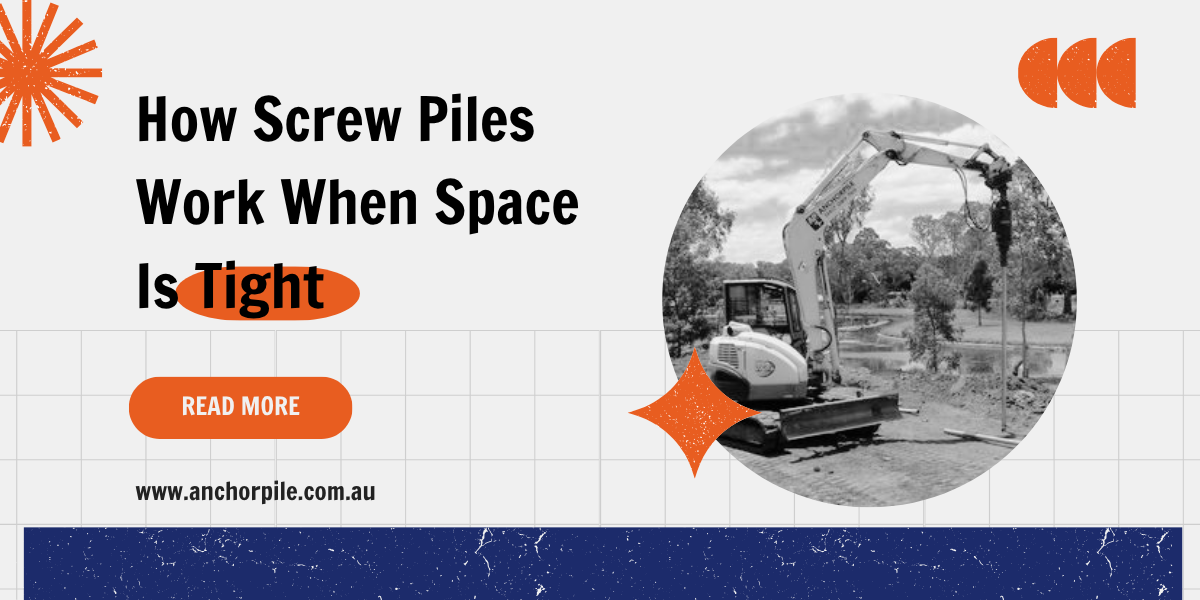
Screw piles remove most of the physical constraints that make conventional foundations difficult on tight sites. The installation process is straightforward: a compact hydraulic drive head, attached to a small excavator or dedicated piling rig, rotates the pile into the ground. No digging, no concrete, no spoil.
The practical implications for restricted access work are significant:
- Minimal equipment footprint. Screw pile rigs are available in configurations from 1 to 6 tonnes. The smaller rigs can pass through a 1 metre side passage and operate under low overhead clearances, making them suitable for the majority of restricted access residential situations in Adelaide.
- No spoil removal. Because the pile displaces soil rather than removing it, there is nothing to cart away. On a site where skips cannot be positioned or trucks cannot access, this alone can be the difference between a feasible job and an impossible one.
- No concrete trucks. Screw piles are all-steel, installed and complete in a single operation. The slab contractor can begin work the following day. There is no waiting for concrete deliveries or curing periods.
- Low noise and vibration. The installation process produces far less vibration than driven piles or heavy excavation. This matters on occupied sites and on projects near existing footings or heritage structures where ground vibration poses a risk.
- Instant load verification. Torque is measured continuously during installation. The load capacity of each pile is confirmed in real time, without the need for load testing after the fact. On a restricted site where re-mobilisation is expensive, getting it right the first time matters.
Common Restricted Access Applications in SA
Across South Australia, screw piles are regularly used in the following restricted access scenarios:
- Rear unit and granny flat construction on existing residential lots, where the only access is through a side gate or passage
- Home extensions built alongside occupied dwellings, where excavation noise and vibration are not acceptable to residents
- Underpinning of existing structures where internal or under-floor access is the only option
- Infill development in established suburbs where sites are bounded by existing dwellings on multiple sides
- Sloped Adelaide Hills blocks where the combination of gradient and limited access rules out conventional excavation plant
- Renovation projects on sites with protected trees, where minimal ground disturbance is a planning requirement
What Builders Need to Confirm Before the Job
Even with screw piles, a restricted access site requires upfront planning to run smoothly. Before installation, the following should be confirmed:
- Access route dimensions. Measure the narrowest point of the access path, including any gates, and confirm the minimum headroom along the route. Share these with the screw pile installer so the right rig is selected.
- Underground services. A Dial Before You Dig check is required. On tight sites, services are often routed in unexpected locations, and knowing their position before installation avoids costly delays.
- Geotechnical report. The engineer’s pile design is based on soil data. Even on a restricted site, a soil test is required to confirm pile depth, diameter and helix configuration.
- Neighbour notification. On sites with shared boundaries or adjacent structures, advising neighbours before work starts is good practice and avoids disputes during installation.
Key Points for Builders
- Tight access is not a reason to default to a conventional footing. It is a reason to specify screw piles from the start. Redesigning the foundation after a bored pier quote falls apart on site is expensive and delays the programme.
- Rig selection matters. Not all screw pile equipment is the same. Confirm the rig dimensions with your installer before the job is booked and verify they can physically access the foundation area.
- No spoil is a real advantage. On sites where waste removal is difficult or costly, eliminating soil disposal from the scope of work is a meaningful saving.
- Certification is the same as any other foundation. Screw piles are fully compliant under AS 2159. A torque log and Certificate of Compliance are provided on completion, satisfying council and building certifier requirements.
Working on a tight access site in SA?
We have the rigs and the experience to work on restricted access sites across South Australia. Tell us your access constraints and we will confirm what is possible before you commit to a design.