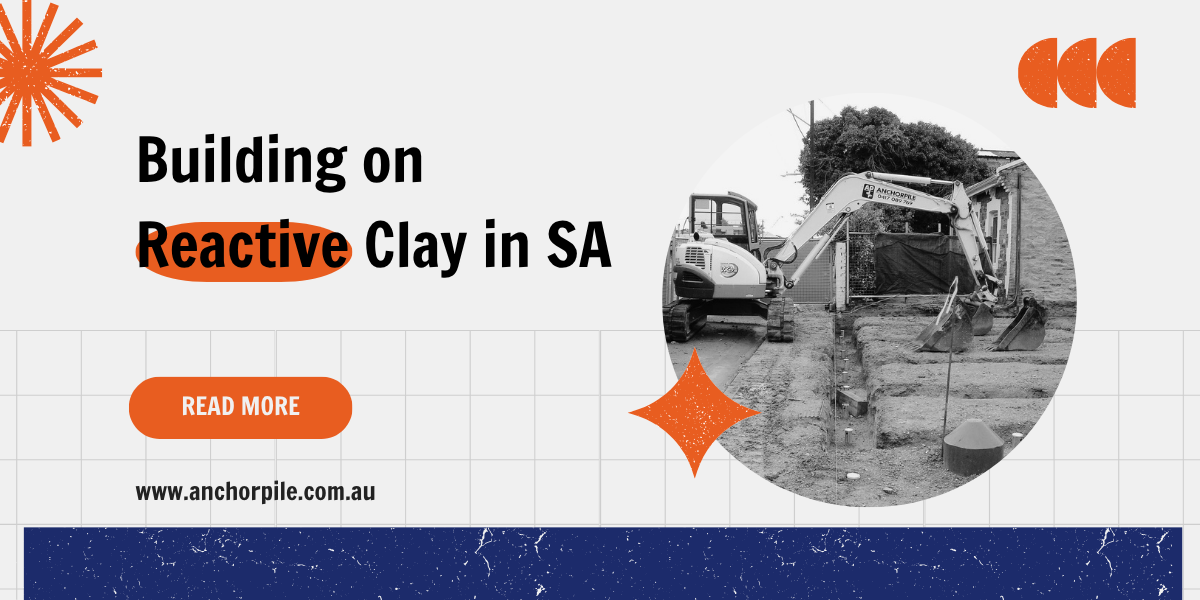
If you have been building in South Australia for any length of time, reactive clay is not a new problem. It is the default condition on most Adelaide building sites, from the inner suburbs out to the growth corridors in the north and south.
The clay expands when it absorbs moisture. It contracts when it dries out. That cycle of movement is what lifts slabs, cracks footings and generates the kind of structural callbacks that are expensive to fix and hard to explain to a client.
Understanding why reactive clay behaves the way it does, and why the traditional response to it often falls short, is the first step to choosing a foundation system that actually holds up over time.
What Makes Soil Reactive?
Reactive soils contain clay minerals that change volume depending on their moisture content. The most common of these in South Australia is montmorillonite, a highly expansive clay mineral found extensively across the Adelaide Plains and surrounding regions.
When moisture enters the soil, the clay particles absorb water and swell. When the soil dries out during summer or drought, those same particles shrink. The result is a ground surface that moves up and down across the seasons, sometimes by several centimetres in highly reactive sites.
This movement is not uniform. Different parts of a site can have different moisture conditions at the same time, particularly around the edges of a slab where vegetation, paving or roof drainage affects moisture distribution. Differential movement is what causes the most damage.
How Reactive Clay Is Classified in SA
Australia uses a classification system for site reactivity. The geotechnical report for a site will typically assign one of the following classifications.
A Class S site is a slightly reactive site with minor surface movement expected. A Class M site is a moderately reactive site, common across much of Adelaide. A Class H1 or H2 site is a highly reactive site where significant movement is expected. A Class E site is an extremely reactive site requiring specialist engineering.
The majority of residential building sites across Adelaide fall into the Class M to Class H range. This means that for most builders in SA, reactive clay is not an edge case. It is the standard condition they are designing and building for on every project.
Why Concrete Footings Struggle on Reactive Sites
The conventional response to reactive clay in residential construction has been to engineer the slab and footing system to accommodate the expected movement. This typically involves using a thickened edge slab, increased reinforcing steel, or a waffle pod raft, designed to move as a rigid unit rather than crack under differential soil movement.
This approach works on lower reactivity sites when the engineering is done well and the slab is maintained properly. But it has limitations.
The footing sits within the reactive layer. The soil movement acts directly on the footing, and the slab has to resist that force through its structural rigidity. Over time, particularly when drainage conditions change around the building, that resistance can be overcome. Trees planted close to the structure, changes to paving or landscaping, and periods of extreme drought or heavy rainfall can all shift the moisture balance enough to cause movement that the slab was not designed for.
When a slab on a reactive site cracks or moves, the repair is disruptive and expensive. In some cases the damage is significant enough to require underpinning, which is a far larger intervention than getting the foundation right at the beginning.
How Screw Piles Solve the Reactive Clay Problem
Screw piles take a fundamentally different approach. Rather than designing a footing that sits in the reactive layer and tries to manage the movement, screw piles are driven through the reactive layer entirely and locked into stable, non-reactive soil below.
The depth required to reach stable bearing soil varies across SA. In many established Adelaide suburbs, the reactive clay layer extends to between 1.5 and 3 metres below surface. In some northern and southern growth areas, it can be deeper. The geotechnical report for the site will specify the depth at which competent bearing material is encountered, and that becomes the minimum installation depth for the pile.
Once the pile is in stable ground, the structure above is essentially decoupled from the reactive surface layer. The clay can expand and contract through the seasons as it always has, but that movement is no longer transmitted to the building. The pile passes through the clay but is not supported by it.
This is the core engineering principle behind why screw piles perform reliably on reactive sites where concrete slab systems struggle.
The Additional Advantages on Clay Sites
Beyond the structural logic, screw piles offer several practical advantages specific to clay conditions in SA.
Installation does not require excavation into the clay, which means there is no spoil to manage or remove. Clay spoil is heavy, often classified as reactive material and can be difficult to dispose of cost-effectively. Eliminating it simplifies the project.
There is no concrete to pour into a clay-heavy excavation, which removes the risk of water infiltration compromising the concrete during or after placement. Clay soils can behave unexpectedly during excavation in wet conditions, and keeping the foundation process above ground rather than in the soil reduces that exposure.
The installation process is also fast. A full residential pile set can typically be completed in a single day, and the structure can be loaded immediately after installation. There is no curing period and no waiting on weather conditions to clear before work can proceed.
What the Engineering Process Looks Like
Every Anchorpile screw pile installation in SA follows a consistent engineering process.
The starting point is the geotechnical report for the site. The report provides the soil profile, the reactive soil classification, the depth to competent bearing material, and the bearing capacity of the foundation stratum.
From that report, the Anchorpile engineer specifies the pile diameter, helix configuration, minimum installation depth and target installation torque for each pile location. The specification is tied directly to the structural loads from the building design and the actual ground conditions at that specific site.
During installation, the crew monitors and records the torque as each pile is driven. When the pile reaches the specified minimum torque at or below the required depth, it has achieved the designed bearing capacity. Those records form part of the project documentation.
On completion, a Certificate of Compliance is issued under AS2159, the Australian Standard for piling design and installation. That certificate documents what was installed, to what specification and to what verified bearing capacity.
Is Screw Pile Foundation Right for Your Reactive Clay Site?
The answer for most SA residential and commercial sites is yes, and the starting point is always the geotechnical report. If you have one, send it through. Anchorpile will review the site conditions and come back with a fixed-price proposal and a clear recommendation on the right pile specification for your project.
If you do not yet have a geotechnical report, we can point you in the right direction.
Anchorpile is a division of IdealCorp. Engineered screw pile supply and installation across South Australia. AS2159 certified. Certificate of Compliance on every project.