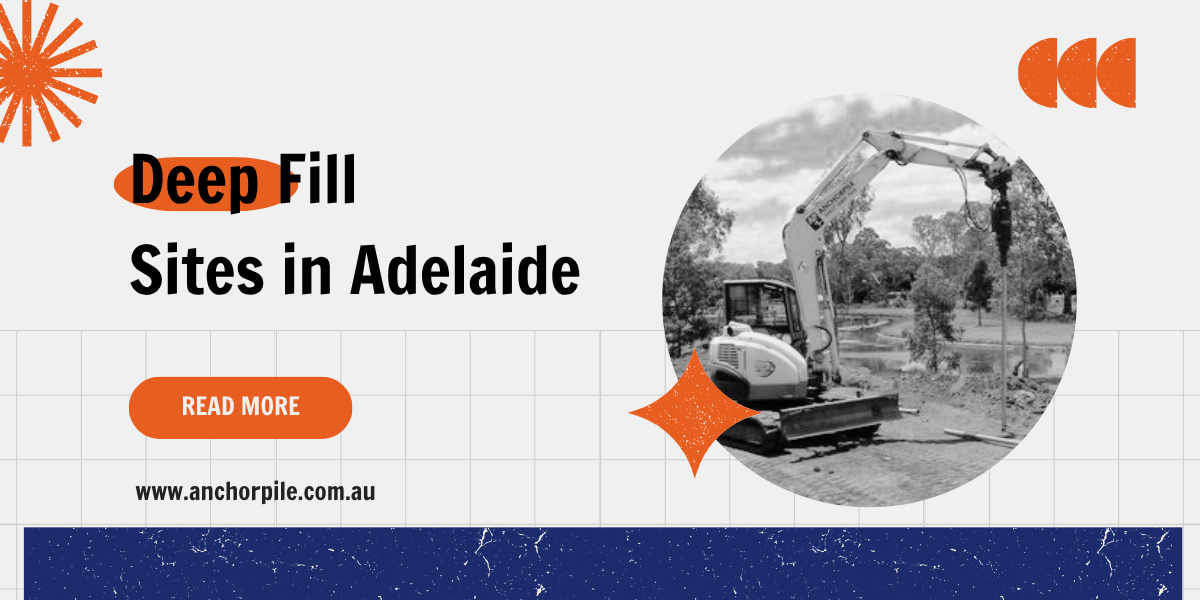
If you are building on a deep fill site in Adelaide, the standard footing design is almost certainly not going to cut it. Getting this wrong leads to cracked slabs, differential settlement and failed inspections, all of which are expensive to fix after the fact.
This guide breaks down what deep fill sites actually are, why they are classified as Class P under AS 2870, and what experienced builders need to know before they pour a single slab on one.
What Is a Deep Fill Site?
A deep fill site is any lot where the ground has been built up using imported or excavated material, typically to level a sloped block, reclaim low-lying land or prepare a subdivision. The depth of this fill can range from a few hundred millimetres to several metres below finished ground level.
What makes deep fill different from natural ground is compressibility. Even when fill has been engineered and compacted correctly, it behaves differently from undisturbed soil. When fill is uncontrolled, placed without proper engineering specification, the risk increases substantially.
Under AS 2870-2011, deep fill sites are treated as Class P (Problem sites) unless a Geotechnical Engineer certifies that the fill was placed in accordance with an appropriate specification. Standard deemed-to-comply footing designs do not apply.
Where Deep Fill Sites Appear in Adelaide
Adelaide’s building landscape includes a significant number of deep fill sites, particularly in:
- New residential subdivisions in the outer north and south corridors, where land grading has altered natural levels across entire estates
- Infill development sites in established suburbs where old structures have been demolished and rubble mixed into the fill profile
- Sites near the foothills where cut-and-fill earthworks are used to create level building pads on sloping terrain
- Low-lying coastal and flood-prone areas raised using imported fill to meet minimum floor level requirements
The challenge in Adelaide is that a site-wide classification issued by a developer may not reflect variations at an individual lot level. Two adjacent lots in the same estate can behave very differently if the fill depth changes significantly between them.
Why Standard Footings Fail on Deep Fill
The core problem with deep fill sites is settlement, specifically differential settlement. When different parts of a slab sit on fill of varying depth or density, they move at different rates as the fill compresses over time.
This creates the conditions for:
- Slab cracking and beam deflection beyond the tolerances set out in AS 2870
- Wall cracking in masonry veneer construction, which signals real movement in the footing system
- Edge curl and heave at the interface between fill and natural ground, particularly common at the lot boundary
- Long-term settlement that continues for years after construction, especially in uncontrolled fill profiles with organic material present
Conventional stiffened raft slabs are designed to handle reactive clay movement, not the vertical compression that deep fill produces. They rely on the ground providing lateral restraint and consistent bearing capacity, neither of which is guaranteed on a deep fill site.
What the Geotechnical Investigation Needs to Cover
A standard residential soil test is not sufficient for deep fill sites. The investigation needs to go much deeper to characterise the full fill profile and the natural soil below it.
A thorough geotechnical report for a deep fill site in Adelaide should include:
- Fill depth and composition, confirmed by drilling or dynamic cone penetrometer (DCP) testing to natural ground
- Compressibility assessment using laboratory or field testing to estimate likely settlement magnitude and rate
- Bearing capacity of the natural stratum below the fill, to confirm a competent layer exists that piles can be founded into
- Controlled vs. uncontrolled fill determination, with engineer certification if applicable
- Corrosivity assessment to determine the required level of corrosion protection for any steel foundation elements
Without this information, it is not possible to design a compliant or reliable footing system for the site.
Why Screw Piles Are the Right Solution
On a deep fill site, the footing system needs to do one thing above all else: bypass the fill entirely and transfer the building load into competent natural soil or rock below.
Screw piles, also called helical piers, are purpose-built for exactly this. The pile is rotated through the fill profile using hydraulic torque equipment until it reaches and locks into the load-bearing stratum. The torque measured during installation directly correlates to the pile capacity, giving the engineer real-time verification that each pile has achieved its design load.
A full set of screw piles for a residential slab can typically be installed in a single day. There is no excavation, no soil disposal, no concrete trucks and no curing time. The slab can follow the very next day.
Compared to conventional bored concrete piers, screw piles have a clear advantage on deep fill sites in three specific situations:
- Sandy or loose fill is present. Bored piers in these materials tend to blow out in diameter as the sides of the hole collapse, making capacity unpredictable. Screw piles penetrate by displacement with no open hole.
- Deep penetration is required. Once a bored pier exceeds approximately 2.7 metres in depth, the cost and complexity of concrete placement increases significantly. Screw piles maintain consistent installation costs regardless of depth.
- Access is restricted. Screw pile rigs can operate in spaces as narrow as 1 metre wide, making them practical for tight allotment boundaries and sites with existing retaining walls.
The Process: What Builders Should Expect
For builders working with us on deep fill sites in Adelaide, the typical process looks like this:
- Geotechnical investigation. We coordinate with your geotech or can provide a referral. The soil report is the foundation of the whole design.
- Engineer design. A structural engineer reviews the geotech report and specifies pile diameter, spacing, depth and cap details.
- Installation. Our crew installs the piles to the specified torque, with a torque log produced for every pile as part of the documentation package.
- Slab construction. The slab contractor takes over with a stable, verified foundation ready to build on.
The torque log matters. It is your paper trail confirming that every pile achieved its design capacity, which is essential for inspections and for the engineer sign-off.
Key Takeaways for Builders
- Never assume the developer’s site classification covers your individual lot. Get a lot-specific soil test if there is any doubt about fill depth or composition.
- Deep fill sites are Class P. Standard slab designs do not apply. You need an engineer-designed footing system for every Class P site, no exceptions.
- Screw piles are not a workaround. They are the correct engineered solution for bypassing fill and founding into competent natural soil. They are fully compliant under AS 2159 and the NCC.
- Speed and programme matter. Screw piles are installed and ready to load on the same day, with no wet weather delays and no curing windows to work around.
Working on a deep fill site in Adelaide?
We have installed screw pile foundations on deep fill sites across Adelaide and South Australia. Contact our team for a quote or to talk through your geotech report.