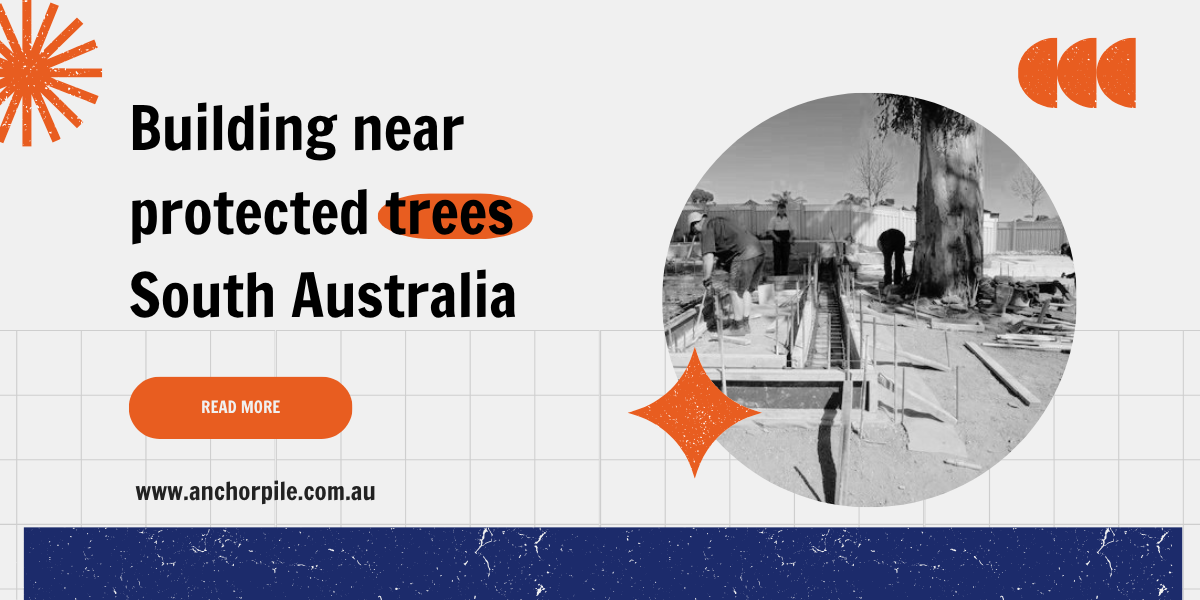
Tree protection laws in South Australia tightened significantly in May 2024, and a lot of builders are still catching up. If your project sits near a mature tree, whether on the same lot or an adjoining property, there is a real chance that tree is now protected under the new regulations and that your standard footing approach will not get planning approval.
This guide covers what changed, what it means on site, and how screw piles have become the go-to foundation solution for projects near protected trees.
What Changed in May 2024
The SA Government introduced new regulations under the Planning, Development and Infrastructure Act 2016 that took immediate effect from 16 May 2024. The changes were significant and caught many builders and developers off guard.
The key updates were:
- Regulated tree threshold reduced. A tree is now classified as regulated if its trunk circumference is 1 metre or more when measured 1 metre above ground. Previously the threshold was 2 metres, meaning a large number of trees that were previously unprotected are now regulated.
- Significant tree threshold reduced. The circumference for significant tree classification dropped from 3 metres to 2 metres.
- Exemption distance cut from 10 metres to 3 metres. Under the old rules, trees within 10 metres of a home or pool could be removed without approval. That exemption now applies only within 3 metres. This is the change that has the most direct impact on builders.
- Protections extended beyond metro Adelaide. The new rules now apply to townships and greenfield developments across SA, not just the metropolitan area.
- Pruning limits introduced. No more than 30 percent of a regulated or significant tree’s canopy can be removed within any five year period.
Penalties for undertaking tree-damaging activity without approval can reach $120,000. Any work that damages a regulated or significant tree, including excavation that severs roots, requires development approval from the relevant council.
What Counts as a Tree-Damaging Activity
This is where builders need to pay close attention. Under the PDI Act 2016, a tree-damaging activity is not limited to cutting a tree down. It includes any activity that could damage the tree, and that definition has been tested in case law.
For a construction context, the following can all constitute a tree-damaging activity:
- Excavation that severs or damages roots within the tree’s root zone
- Trenching for services such as stormwater, sewer or electrical conduits that pass through the root zone
- Soil compaction from heavy machinery operating near the tree
- Concrete poured near the base of the tree that blocks oxygen and water movement to the root system
- Excessive pruning of branches to allow access for construction
The practical takeaway is that a conventional footing system, with its requirement for excavation, trenching and concrete placement, is often incompatible with building near a protected tree.
Understanding the Root Protection Zone
The root system of a mature tree extends well beyond what most people expect. Research consistently shows that up to 90 percent of a tree’s roots lie within the top 600 mm of soil, and they radiate outward far beyond the canopy edge.
For planning and arboricultural purposes, a Root Protection Zone is typically calculated based on the tree’s trunk diameter at breast height. The council’s assessment of your DA will consider whether your proposed works intrude on this zone and what measures are in place to protect the tree.
Builders working near regulated or significant trees in SA should expect the council to require one or more of the following:
- An Arboricultural Impact Assessment prepared by a qualified arborist
- A Tree Protection Plan specifying exclusion zones, protective fencing locations and construction methodology
- Evidence that the chosen foundation system will not compromise tree health
An Arboricultural Impact Assessment is not optional on most projects involving regulated trees. Submitting a DA without one, where one is clearly required, will stall the assessment process and push out your programme.
Why Conventional Footings Are a Problem Near Trees
Traditional strip footings, pad footings and even bored concrete piers all require varying degrees of ground excavation. Near a protected tree, that excavation creates two specific problems.
First, the physical act of digging severs roots. Major roots above 25 mm in diameter are critical to the tree’s structural stability and water uptake. Severing them can trigger decline, increase wind throw risk and in some species cause rapid deterioration.
Second, concrete placed near tree roots creates a barrier that restricts oxygen and water movement through the soil. Compaction from machinery causes the same problem by reducing soil porosity. Both outcomes are harmful to tree health and are likely to be flagged by the arborist reviewing your DA.
On a reactive clay site, there is an additional complication. Trees actively dry out the soil around them, creating seasonal moisture variation that drives heave and shrinkage. A conventional slab or strip footing that relies on consistent bearing capacity at shallow depth will be affected by this movement for the life of the building.
Screw Piles: The Foundation Solution That Works Near Trees
Screw piles have become the preferred foundation system for projects near protected trees, both in SA and across Australia. The reason is straightforward: they require no excavation and cause minimal soil disturbance.
The pile is rotated into the ground using hydraulic torque equipment. Rather than removing soil, the helical plates displace it. The pile shaft is slim relative to the footprint of a conventional footing, and installers can adjust pile positions to work around visible surface roots. When a major root is encountered during installation, the pile location can be shifted without redesigning the whole foundation.
Screw piles are widely accepted by arboricultural consultants and planning authorities as a compliant foundation solution within Root Protection Zones. Having screw piles specified in your Tree Protection Plan significantly strengthens your DA application.
There are additional structural advantages that matter specifically on tree-affected sites:
- Depth below the root zone. Screw piles can be designed so the load-bearing helices sit below the zone of root activity and seasonal moisture variation, typically at 4 metres or deeper on reactive clay sites. This isolates the structure from soil movement driven by tree water uptake.
- No concrete near roots. Unlike bored piers that require concrete backfill, screw piles are all-steel. There is no risk of concrete sealing the soil surface or migrating toward root systems.
- Immediate load bearing. There is no curing time. The structure can be framed the day after pile installation, reducing the period of site activity near the tree.
- Tight access capability. Screw pile rigs can operate in spaces as narrow as 1 metre. This matters when the tree canopy or fencing limits equipment access to the foundation area.
The Approval Process: What Builders Should Expect
For any project near a regulated or significant tree in SA, the DA process will typically involve the following steps:
- Identify whether the tree is regulated or significant. Check the tree’s trunk circumference and confirm it is not on the exempt species list published on the PlanSA portal. For significant trees in certain council areas including Adelaide, Burnside, Prospect and Unley, also check Part 10 of the Planning and Design Code.
- Commission an Arboricultural Impact Assessment. A qualified arborist will assess the tree, define the Root Protection Zone and advise on what construction methods are acceptable.
- Prepare a Tree Protection Plan. This document specifies protective fencing, exclusion zones, approved construction methodology and any conditions on the use of machinery near the tree.
- Specify the foundation system. Having screw piles documented in your Tree Protection Plan as the chosen foundation method demonstrates to the assessment manager that root disturbance has been addressed.
- Lodge the DA. The council’s assessment manager reviews the application. Most applications involving regulated trees will incur a fee, currently $1,000 for regulated trees and $1,500 for significant trees under the 2024 regulations.
Getting the arborist and engineer working together early in the design process saves time and avoids costly amendments to the DA after lodgement.
Key Points for Builders
- Check the tree before you design the footing. With the 2024 changes, many trees on or near your site that were previously unprotected are now regulated. Measure trunk circumference early and check the PlanSA portal.
- The 3 metre exemption is much smaller than most people think. If any part of your proposed works, including service trenches, falls more than 3 metres from the dwelling or pool and within the root zone of a protected tree, you need approval.
- An arborist is not optional. Councils will require an Arboricultural Impact Assessment for most DAs involving regulated trees. Factor this into your programme and budget.
- Screw piles simplify the DA. A foundation system that requires no excavation is far easier to defend in a planning assessment than conventional footings. Arboricultural consultants routinely specify screw piles as the acceptable method for work within Root Protection Zones.
Building near a protected tree in SA?
We have installed screw pile foundations on tree-sensitive sites across South Australia. Our team works alongside arborists and engineers to keep your DA on track and your tree intact. Get in touch to discuss your project.